


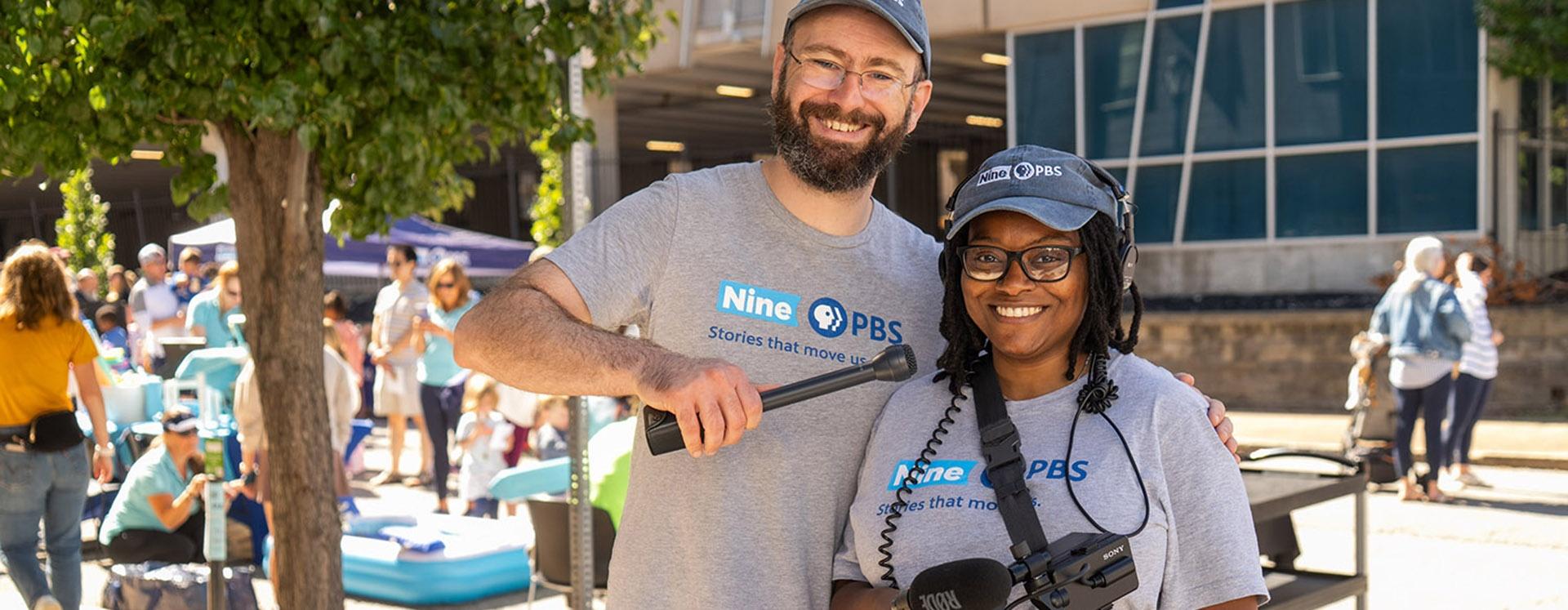
Public media exists to serve its local community, not shareholders, advertisers, or algorithms. No matter where you live, your local public media station is there for you, on air, online, and on the ground.
But what does that actually mean?
Most media today is built around an audience advertisers want to reach. Traditional mainstream programming exists to deliver advertisements to consumers. But public media believes in serving communities and learners, not selling to them.
Public media stations, like Nine PBS, are nonprofit organizations. Our goal isn’t to make a profit, it’s to make an impact.
That's not marketing language. It's a structural reality. When you support a public media station, you're not a customer. You’ve become part of a station solely dedicated to serving the community you live in.
Public media began as radio, then grew into television. Today it's something much broader: podcasts, digital series, community events, educational programs in schools, and resources for families across the region. All free, and accessible to everyone, on air, online, all the time.
Nine PBS was founded in 1954 and is a PBS member station—a large network of 336 independently operated PBS stations across the country. PBS was founded in 1969, born out of a conviction that the American public deserved a broadcasting system built around education and civic life rather than commercial interests.
Because public media isn't chasing advertisers or ratings, it can afford to do something rare, follow the story wherever it leads. Editorial decisions at stations like Nine PBS are made by journalists and producers, not by sponsors or political pressure.
You may have also noticed brief sponsor messages during Nine PBS programming; those are called underwriting messages. Underwriters are businesses or organizations that financially support public media and receive a simple acknowledgment of that support, not an advertisement. Unlike traditional advertising, these messages follow strict Federal Communications Commission (FCC) guidelines that prohibit promotional language, meaning underwriters have no influence over the content we produce or the stories we tell. The firewall between funding and editorial decision-making is what keeps public media independent.
That independence is what allows public media to cover a difficult local issue without worrying about losing a funder or spending months on a documentary that a commercial network would never greenlight. It's why generations of Americans have turned to public media for information they can trust, and why that trust, once built, tends to last. In fact, according to a yearly survey conducted by Proof Insights, PBS has ranked #1 as the most trusted media institution for 23 consecutive years.
But if there are no commercial dollars, how do we stay on your screen?
Public media is supported by viewers like you. Our station, and public media across the country, runs mainly off individual donations.
No single funder, corporate or political, can direct what stories get told or which communities get served. When you become a member of Nine PBS, you're not just keeping the lights on. You're actively protecting the independence that makes public media worth watching in the first place. Nine PBS answers to its community because it is funded by its community.
Beyond the screen, public media stations across the country, including Nine PBS, run early literacy initiatives, professional development for educators, and community engagement efforts aimed at the neighborhoods that need them most. Meaning that public media isn’t just something you watch; it’s something that shows up for you.
In a media landscape increasingly dominated by algorithms, engagement metrics, and outrage-driven content, public media remains committed to something older and more durable: the idea that an informed, connected community is a stronger one.
In St. Louis, that commitment has a name, Nine PBS.
By Gabrielle Lindemann, contributing writer