


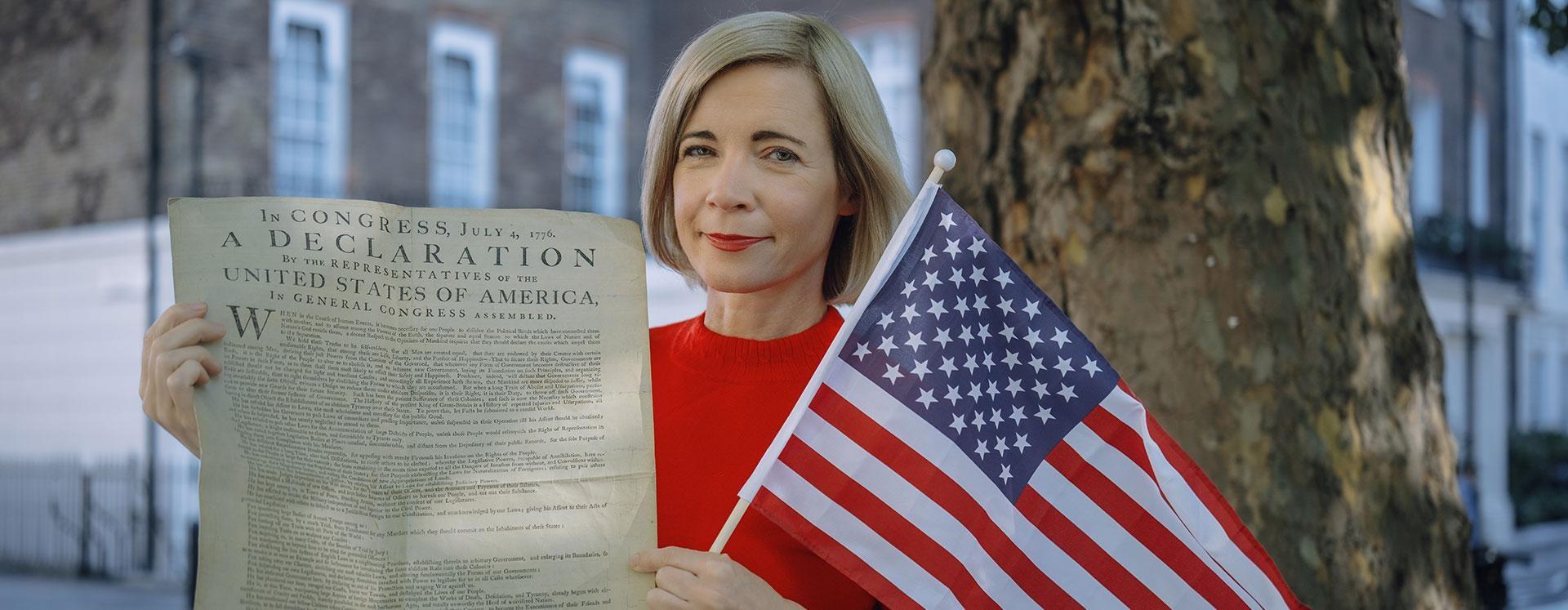
Over two episodes of Lucy Worsley Investigates: The American Revolution, Worsley brings her signature wit and contemporary perspective to history as she delves deeper into the American Revolution. By examining it from the British perspective, she discovers the human drama, radical ideas, and political missteps behind this seismic split, and reveals how losing America changed Britain forever.
Part of the PBS America @ 250 special programming lineup, Lucy Worsley Investigates: The American Revolution premieres Tuesday, April 7 and 14, 2026, at 8 pm on Nine PBS and livestream. Stream on the PBS app.
Another Perspective
The story of the American Revolution is often framed as a heroic win over the British government. Brave colonists persevered through horrors like the Boston Massacre to overcome the tyrannical King George III, right?
That’s certainly one perspective on the Revolutionary War. However, as Lucy Worsley discovers, there’s another way to look at the story. While American colonists saw a government treating them unfairly, the king may have seen his relationship with the once-loyal colonies turning into a messy divorce.
Read the full blog post here: The British American Revolution: A Messy Divorce
Watch the six-part docuseries, The American Revolution, from Ken Burns and team with Nine PBS Passport.
Episode 1 | April 7
Lucy travels to New York’s City Hall Park, where George Washington’s troops heard the Declaration of Independence read aloud—a rallying cry that inspired rebels to destroy a statue of King George III and melt it into musket balls. At the New York Historical, Lucy examines a relic of this defiance and asks whether the rupture was inevitable. She then travels home to England to uncover the British perspective, studying King George’s maps and visiting Benjamin Franklin’s London home. She traces British and American tensions rising from Britain’s punitive taxes and the Stamp Act of 1765. In Boston, Lucy explores how the Boston Massacre and Boston Tea Party were flashpoints that pushed Americans toward war. Finally, Lucy reveals the radical voices—John Wilkes and Thomas Paine — whose words crystallized America’s vision of liberty and independence.
Episode 2 | April 14
Lucy uncovers how the war reverberated in Britain itself. At Portsmouth Royal Dockyard, Lucy investigates James Aitken’s shocking arson plot to cripple the Royal Navy. She traces Franklin’s secret mission to Paris to secure French support, while British spy Edward Bancroft fed intelligence back to London. Lucy explores Britain’s growing fears as France—and later Spain—joined the conflict, and how Irish Volunteers forced Britain to lift trade restrictions between Ireland and America. Back in London, riots erupted, and George III agonized over the possibility of losing the empire. By 1781, Britain’s campaign collapsed at Yorktown, and two years later, Britain formally recognized American independence. Concluding her investigation at Grosvenor Square, the site of America’s first embassy in London, Lucy reflects on a revolution that created an independent America and reshaped Britain forever.
Contributed by Lynanne Feilen, communications manager